
Business is interested in voice AI not because bots have learned to speak more pleasantly. What matters more to owners is this: will the agent take the call, understand the request, avoid freezing for five seconds between phrases, and pass the data into the CRM? That’s where the news about Deepgram and Daily becomes practically important.
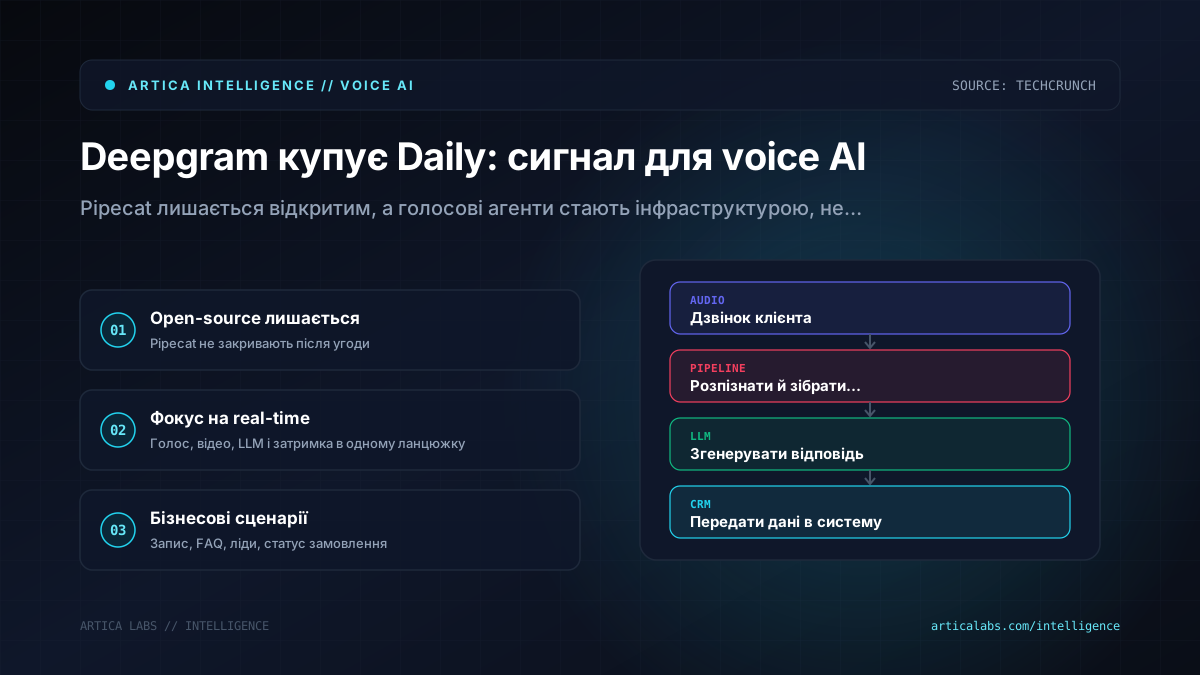
According to TechCrunch AI, Deepgram is acquiring Daily, the company that created and maintains Pipecat, one of the popular open-source frameworks for voice AI infrastructure. The deal amount has not been disclosed. Both companies said Pipecat will remain open source.
Natural AI conversation depends on more than one module
Pipecat is interesting because it stitches together several difficult pieces: voice and video streams, speech recognition, LLMs, text-to-speech, and latency handling. It’s not just a pretty wrapper for a chatbot. It’s the engineering foundation without which AI conversations quickly turn into a clumsy experiment.
Think of a delivery service. A customer calls and asks where their order is. The agent needs to recognize the speech, extract the order number, query the system, compose a response, and say it naturally. If each part lives on its own, the conversation breaks down: pauses, repetitions, bad clarifying questions. That’s why infrastructure that manages the whole chain becomes valuable.
After the deal, Deepgram will gain deeper access to real-time voice and video workflows. The company previously reached unicorn status after a $130 million Series C round. According to PitchBook, Daily has raised more than $62 million. There’s also an interesting historical detail: both companies were in the same Y Combinator batch in 2016.
Daily began experimenting with AI voice and text communication with humans shortly after GPT-4 arrived. That’s where Pipecat grew from. According to Daily co-founder Quindly Kramer, it was essential to him that Pipecat remain open and vendor-neutral. That’s a good signal for the market. Developers don’t want to build voice products on a closed box they can’t easily leave later.
Businesses don’t need to rush into bots tomorrow, but they should pay attention
For small and mid-sized businesses, this deal does not mean the contact center has to be replaced on Monday morning. It shows something else: voice agents are becoming a platform, not a one-off integration in the style of “let’s put a bot on calls.”
The best place to start is with narrow scenarios that involve lots of repetition and a clear definition of success:
- initial booking for a clinic or salon;
- answers to common e-commerce questions;
- lead qualification for an agency or B2B team;
- order status checks for a delivery service.
The challenges are still there. Latency in a voice conversation is more annoying than a slow reply in chat. Poor recognition of Ukrainian or code-switching can break the whole flow. Another risk is dependence on a single model provider. That’s why the open Pipecat and the ability to connect different models look healthy from an architecture perspective.
Conversation context is becoming part of the product
Deepgram is also launching the Real-Time Context Standard, an open protocol for voice agents created together with the Pipecat team. It describes how to pass metadata from audio, such as whispering, how an LLM can use those signals, and how the response should sound.
And that’s where things get especially interesting. A voice agent will be able to react not only to words, but to the context of the conversation. For business, that could mean the difference between “the bot recited the script” and “the agent understood the customer was stressed and responded more gently.” It sounds simple, but technically it’s complex work.
At Artica, our view is this: don’t buy “voice AI” as a magic button. Define one process, calculate how much time it takes people, and test the agent on a limited flow. If the infrastructure is open, modular, and doesn’t lock you into a single vendor, your chances of getting real value are much higher.