
Picture an ordinary Monday. The owner of an online store opens the work chat and sees this: the marketer has generated newsletter copy in ChatGPT, the sales manager is asking whether they can upload a client conversation there, the operations lead is testing an AI note-taker for calls, and the accountant wants to check a formula Copilot suggested.
At first glance, everything looks fine. The team is moving, people are trying new tools. But a week later it turns out the newsletter copy sounds identical, the manager accidentally pasted personal customer data into the chat, the note-taker recorded too much, and the formula only works for part of the spreadsheet. And that’s when things get interesting.
The problem is not that employees are using AI. The problem is that everyone uses it however they think it should be used. One person sees a magic wand. Another worries they’ll be replaced. A third treats AI as a toy for writing. A fourth is waiting for the owner to finally say what is allowed and what isn’t.
Team AI literacy is not about turning everyone into prompt engineers. It’s about a healthy work culture. People understand where AI helps, where it hurts, what can be fed into it, what needs to be checked, and who is responsible for the result.
Start with realistic expectations, not with tools
The worst possible start is to buy access to a popular service and announce, “From now on, we work with AI.” That’s usually how chaos begins. Part of the team experiments actively, part of it silently resists, and a month later the owner asks: where’s the impact?
Impact doesn’t come from access to ChatGPT, Claude, Gemini, Perplexity, or Microsoft Copilot alone. The tool doesn’t know your business, margins, inventory limits, brand voice, legal risks, or the fact that half your customers message you on Telegram after 9 p.m. Your team knows that. So AI should strengthen the workflow, not replace common sense.
Context is a useful reality check too. AIN.ua wrote that Alphabet lost $500 billion in market value after reporting AI-related spending and a slowdown in search ads. That doesn’t prove AI doesn’t work. It’s a reminder that even giant tech companies have to count the cost of infrastructure, experimentation, and bad bets.
For small and mid-sized businesses, the conclusion is simple. You don’t need to copy corporations. You don’t need to build your own model right away, hire an AI department, or redesign every process from scratch. Start with what hurts every week: repetitive emails, manual reports, preparing commercial proposals, handling requests, searching through documents, and coordinating tasks between departments.
An AI-literate team knows how to ask three simple questions. What exactly are we trying to speed up? What result do we consider acceptable? Where should a person verify the answer? Without those questions, training quickly turns into a collection of tricks.
Map the tasks first, then give the neural-net lecture
Many owners want to start with training for everyone: gather the team for two hours, show what AI can do, and inspire people. Sometimes that works as an initial push. But if there’s no connection to everyday work after the session, the excitement fades fast.
A better approach is to take one department or one process. Say, marketing in an agency. Not the vague task “use AI for content,” but something concrete: prepare 10 blog topic ideas based on the client’s positioning, build an article outline, spot weak points in the text, adapt the material for LinkedIn. Right there you can see where AI is useful and where it is dangerous. It can suggest topics, but it can also invent facts. It can shorten text, but lose meaning. It can make the tone more lively, but break the brand.
Or take a clinic. Administrators answer similar questions every day: doctors’ schedules, how to prepare for tests, rescheduling appointments. AI can help with response templates, an internal knowledge base, and onboarding instructions for new admins. But it should not give medical advice or interpret symptoms on its own. That boundary needs to be stated clearly.
For a delivery service, AI can be useful for analyzing complaints, drafting replies, and grouping reasons for delays. But decisions about compensation, disputed cases, or route changes should still be made by a responsible person, at least at the start.
You need the task map not for aesthetics. It shows where training should deliver a practical result. If the team sees that AI is taking the boring part of the job off their plate, resistance drops. If people only hear broad talk about the future, they either get scared or pretend to be interested.
Training works when it’s short, practical, and rule-based
AI training doesn’t look like a traditional course, where a lecturer spends three hours on theory and employees politely nod. A different rhythm works better here: show briefly, apply immediately, review the result, agree on the rules.
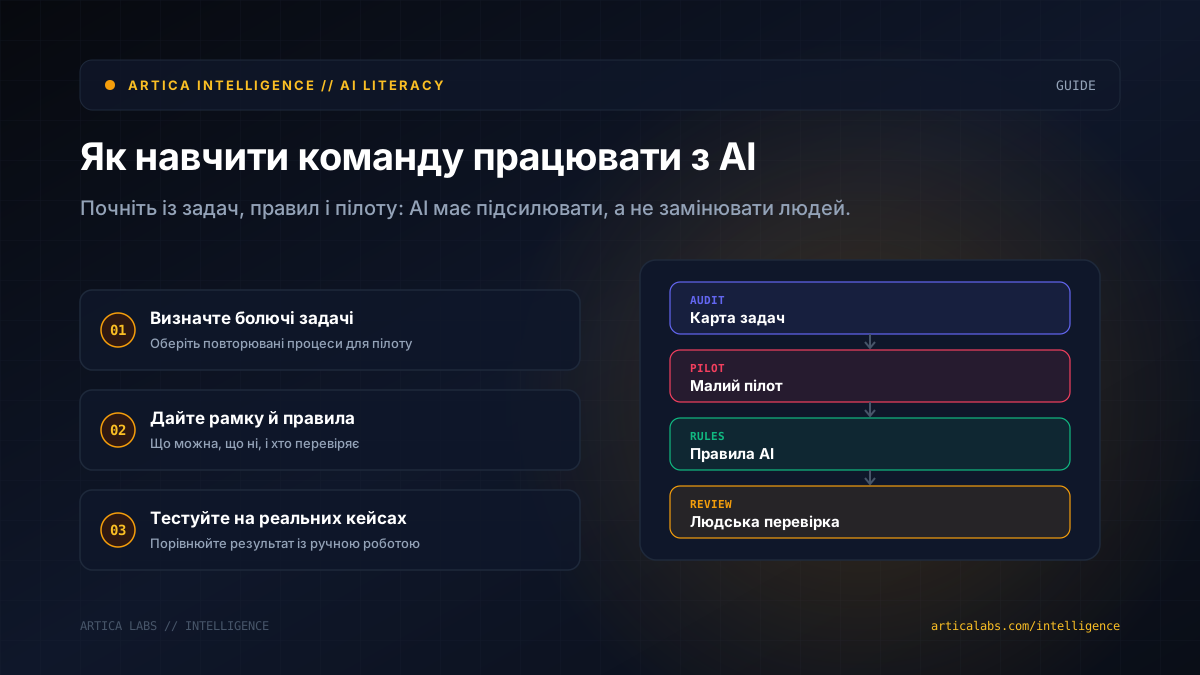
For a small team, it’s realistic to start with a 2–4 week pilot. You don’t need to paralyze the business with a big project. Pick 5–10 people with different tasks and a solid reputation inside the team. Not just the most technical ones. You need people others trust.
At the first meeting, explain the frame. AI is not a boss, lawyer, doctor, accountant, or final editor. It’s an assistant that can speed up a draft, suggest options, structure chaos, and explain complex things in simple language. But responsibility does not move into the model.
Then the team works on real tasks. Not toy examples from the internet, but their own emails, spreadsheets, documents, copy, scripts, and instructions. Without confidential data, if the policy hasn’t been defined yet. A person tries to complete the task with AI, then compares it to how they used to do it. Faster? Better? Worse? Where did they have to redo things?
A practical launch plan might look like this:
- Choose one process or one department for the pilot, where tasks repeat and the outcome is clear.
- List 10–15 typical tasks people handle manually every week.
- Mark which data in those tasks can be used in AI tools and which must not be used.
- Run a short intro session: capabilities, limitations, examples of good and bad prompts.
- Give the team 3–5 working scenarios, not a generic “write better prompts” instruction.
- Agree that every AI-generated result is checked by the person responsible for the task.
- Once a week, collect examples: what worked, where the model failed, what should be prohibited or clarified.
- Write down internal rules on one or two pages, without bureaucratic language.
- After the pilot, decide what to scale, what to stop, and what needs automation through n8n, Make, your CRM, or a knowledge base.
The plan is simple. That’s what makes it powerful. AI literacy is not born from a grand manifesto. It appears when people go through the full cycle a few times: task, prompt, result, review, conclusion.
Data, mistakes, and responsibility: without these rules, it will hurt
The riskiest part of AI training is not prompts. The riskiest part is data. Teams often don’t feel the difference between “help me write this text” and “paste the client’s full history into the service, including phone number, address, and order details.”
That’s why the first rules need to be very grounded. What can be pasted into external AI services? What must be anonymized? Which documents are off-limits? Who approves new tools? Can AI bots be connected to work email, calendars, CRM? What should you do if an employee has already shared too much by accident?
There’s no need to scare people with punishments in the first meeting. It’s better to explain the logic. If an online store manager shares personal customer data in a chat, the company loses control over that information. If a marketer asks AI to write an article and doesn’t fact-check it, the brand publishes nonsense. If HR uses AI to assess candidates without rules, biased decisions can follow.
There’s another annoying thing: AI sounds confident even when it’s wrong. Because of that, beginners often trust a polished answer more than their own review. The team needs to hear this plainly: a convincing style does not equal truth. For legal, medical, financial, technical, and reputational issues, verification is mandatory.
In its October AI digest, Speka wrote about a wide range of topics around artificial intelligence, from business ideas to work with DNA. That’s a good illustration of the information noise around AI. For a business owner, there’s a trap here. When everything sounds possible, it’s easy to forget the limits. But literacy is precisely about not confusing a demo of capabilities with readiness for real operations.
Another topic is copyright and brand voice. If a designer generates images for an ad campaign, they need to understand the service terms. If a copywriter generates text, it needs editing, fact-checking, and a pass to remove clichés. If a salesperson asks AI to draft a reply to a client, they need to check not only grammar but also commercial logic.
How much resource to budget and what not to buy at the start
AI literacy doesn’t require a huge budget at the beginning. But it does require time from a manager or someone who has the authority to change processes. Without that, training turns into a club for enthusiasts.
For the first pilot, a few paid accounts, 1–2 internal facilitators, short weekly sessions, and time for documenting the rules are usually enough. If you have 10–30 people, you don’t need to train everyone the same way right away. Marketing, sales, operations, and finance have different risks. They need different examples.
What definitely shouldn’t you spend money on from day one? A complex custom system without proven scenarios. Dozens of tools that duplicate each other. A “universal course” after which people still don’t know how to apply AI to their CRM, website, warehouse, or document flow.
The other extreme is to buy nothing and say, “Use the free versions.” That’s risky too. First, free tools may have limits in privacy, features, and stability. Second, the company loses visibility: who is using what, what data is being shared, where mistakes happen. Shadow AI already exists in many teams — the owner just doesn’t know it.
The most underestimated resource is adaptation time. Showing someone a prompt is not enough. They need to try it on their own task, make mistakes, see the difference between a bad and a good result, and get examples from colleagues. Only then does AI stop being a gimmick and become a working tool.
Where AI training most often breaks down
The first mistake is training everyone the same way. The owner, marketer, lawyer, clinic administrator, and warehouse manager all work in different contexts. The general part can be shared, but the practical scenarios must differ. Otherwise half the team will listen politely and take nothing back to work.
The second is focusing on prompts instead of processes. A good prompt helps. But if the process is broken, AI just produces a broken result faster. For example, if an agency doesn’t have a proper client brief, AI won’t save the strategy. It will only package the assumptions neatly.
The third is failing to define responsibility. Who is to blame if an AI-prepared proposal contains the wrong price? Not the model. Not the service. The person who sent the document out, and the manager who didn’t define the review process, is responsible.
The fourth is expecting instant savings. Sometimes the team works more slowly in the first few weeks because they’re learning. That’s normal. If you demand results tomorrow, people start hiding mistakes or using AI superficially: rewriting a bit of text, shortening an email a little, playing with ideas a little. The business gains almost nothing from that.
The fifth is ignoring emotions. Some people are afraid AI will take their jobs. Some are angry because they feel their expertise is being devalued. Some are excited and start automating everything in sight. The manager needs to make the position clear: we are introducing AI to remove routine work, improve quality, and move faster, but human professional judgment is still needed.
And there’s one more mistake, less obvious. The company trains people to use AI, but doesn’t change the processes. Then an employee drafts something faster, but still has to go through five manual approvals, copy data between spreadsheets, and wait three days for a manager’s reply. In that environment, AI literacy quickly hits a ceiling. After training, you often need to move on to automation: integrations between services, an internal knowledge base, bots for common requests, semi-automated reports.
Teach the mindset, not just the AI
We’re skeptical of stories that present AI as magic. In business, magic doesn’t scale well. Rules, skills, accountability, and solid processes do.
Team AI literacy is not a one-off workshop and not a folder of prompts. It’s a new hygiene of working with information. People need to learn how to frame a task, provide context, verify the answer, protect data, and honestly admit where the machine helped and where it made things up.
It’s better to start small. One process. One team. One pilot. Not because you should be afraid of AI. Because business needs not impressions, but controlled change.
If after a month the team has a few working scenarios, simple safety rules, a shared language for discussing mistakes, and a clear understanding of where automation is needed, that’s already a strong start. From there you can build deeper: RAG knowledge bases, AI agents, CRM integrations, training programs for departments. But the foundation stays the same: people need to understand what they are doing.
At Artica Academy, we look at AI training exactly this way: not as a show of tools, but as practical work that has to take root in the team’s real day-to-day operations. Because business doesn’t need wow demos — it needs the calm confidence that we know where AI helps us, and we know where it has to be stopped.