
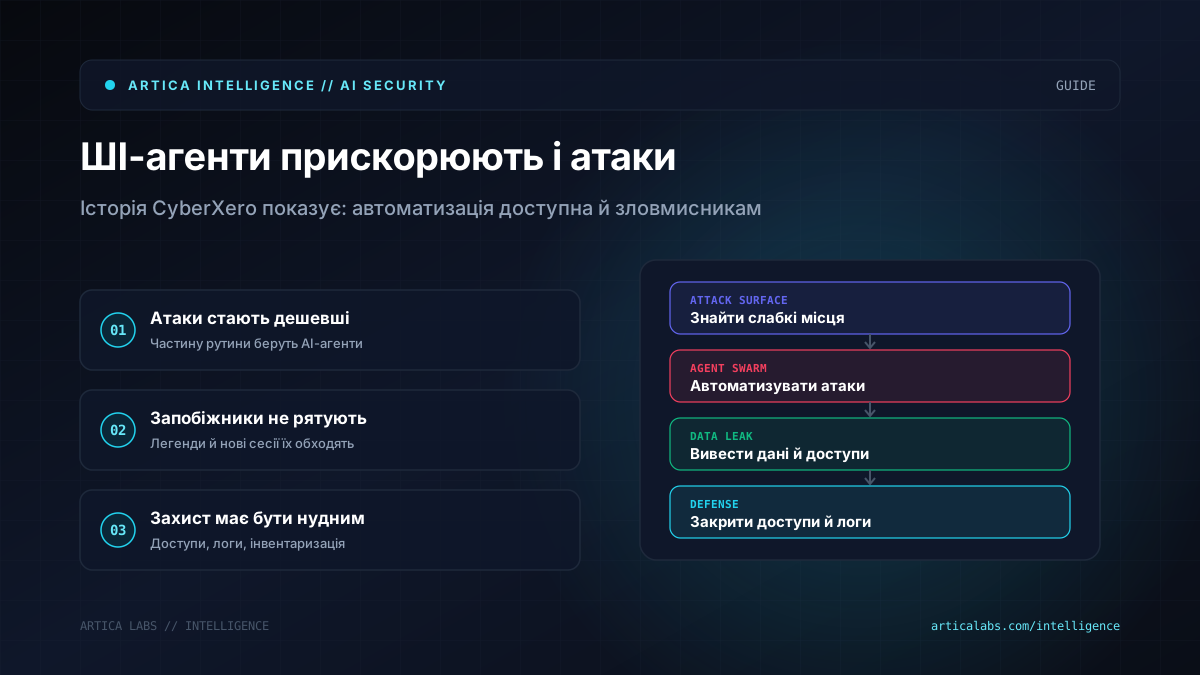
This story is painful for business not because of Claude Code or the headline names of energy companies. It’s about something else: attacks are getting cheaper, faster, and more accessible to people who no longer have to do everything manually.
Picture an online store on WordPress, a clinic with patient portals, or a delivery service with an admin panel that was hastily patched together before peak season. In the past, a hacker could spend hours manually looking for weak spots. Now part of that routine can be handed off to AI agents. And that’s where things get interesting. Security has to be not just pretty in a presentation, but a little boring: regular, technical, and disciplined.
AI agents can already work like an attacking team
According to MC.today, citing SOCRadar, a Russian-speaking hacker operating under the alias CyberXero stole data on more than 628,000 Ukrainians and carried out reconnaissance against seven energy and utility companies. Targets mentioned include DTEK and Ukrenergo, although researchers did not confirm any successful compromise of those companies.
The largest confirmed leak involved a heat supplier in Kharkiv: 564,073 subscriber records with personal data, home addresses, and account numbers. Another 213,000 login records with IP addresses are also mentioned. For a city close to the front line, this is not just about privacy. Data like this can also affect people’s physical safety.
According to the source, CyberXero used a swarm of 51 AI agents based on Claude Code. Each had its own role. Some looked for targets and subdomains, others tried passwords, built attack scenarios, or exfiltrated data. For DTEK and Ukrenergo, he compiled a list of 95 subdomains, including mail, VPN, dispatch systems, and data platforms.
One episode shows the scale of automation especially clearly. In a single run, the system scanned 4,708 websites, gained access to 429 admin panels, and deployed 32 web shells. The whole thing took 61 seconds. The hacker received notifications about successful compromises in a Telegram bot.
The model may refuse. The processes around it don’t always hold up
There’s one telling detail: the AI repeatedly refused to carry out dangerous commands. For example, installing a backdoor, disabling the firewall, or deploying a web shell. The hacker worked around this by claiming it was an authorized pentest of his own infrastructure. If that didn’t work, he opened a new session and tried again.
In other words, built-in safeguards do work, but they are not a concrete wall. Businesses shouldn’t rely only on an AI provider’s policies. They need their own rules: who has access, what automation is allowed to run, where logs are stored, and who reviews them.
Practically, we’d start with the following:
- check whether passwords are stored in scripts, repositories, or Make- or n8n workflows;
- close unnecessary admin panels, VPNs, test subdomains, and old WordPress sites;
- enable logging for user actions and service accounts;
- separate access rights, because an AI agent does not need administrator privileges everywhere;
- regularly inventory subdomains and external services.
It’s telling that CyberXero was exposed by his own carelessness: an open folder on a server with no protection. It contained more than 90,000 files, AI session logs, scripts with plaintext passwords, and stolen databases. Thanks to that, researchers traced eight servers.
Our position at Artica is simple. AI accelerates not only sales, support, and operations. It also accelerates mistakes, access chaos, and weak cyber hygiene. If your business is already deploying agents, automations, or RAG systems, security has to be built in from day one. Not after the first incident.