
For business, this news is interesting not because of the military angle. It points to something else: AI works best where there’s a lot of scattered data, little time to decide, and mistakes are expensive.
In companies, the stakes are different, but the logic is very familiar. When should you reorder stock? Where should you move couriers? Which ad channel should you cut, and which one should you keep a little longer? This is not the front line, of course. But a business owner is also making decisions in a constant state of incomplete information.
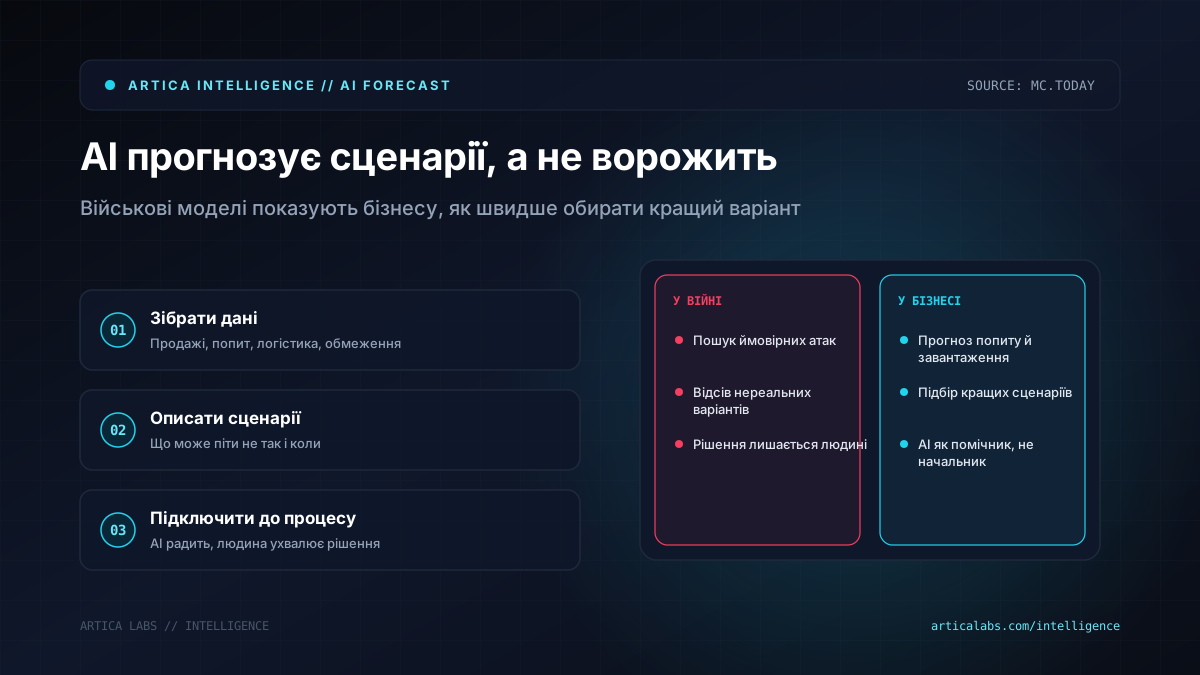
As MC.today writes, Ukraine and NATO have developed two artificial intelligence models for the military. “Model No. 13” predicts where, when, and with what kinds of drones Russia may attack. “Model No. 32” helps plan artillery operations. They were created by NATO’s Allied Command Transformation and the Armed Forces of Ukraine with the participation of the NATO-Ukraine joint center JATEC. The Ministry of Defense announced this on October 14.
AI does not predict the future. It calculates scenarios based on solid data
“Model No. 13” analyzes previous battles, weather, and the current battlefield situation. Based on that, it identifies — with a high degree of probability — the intensity of attacks, the areas, timing, and types of enemy drones. According to the Ministry of Defense, the model has already been tested on real datasets, refined, and is now being prepared for integration into the Armed Forces of Ukraine’s digital situational awareness systems.
And this is where it gets especially interesting for business.
Because, in essence, this is very similar to good demand forecasting. Imagine an e-commerce store. It has sales history, seasonality, inventory levels, ad campaigns, weather, and customer behavior. AI is not supposed to “predict destiny.” It can show likely scenarios: where demand will peak, what may run out, and which items could end up sitting in stock.
The same applies to a clinic. There are patient records, doctor workloads, canceled appointments, reminders, and follow-up visits. A good model can help with scheduling and workload distribution, instead of just producing another nice-looking dashboard that no one opens after the first week.
Humans should stay in the loop, and for companies that’s the healthy approach
“Model No. 32” works as a decision-support tool for artillery personnel. It takes into account the task, available weapons and ammunition, the location of firing positions, and existing constraints. First, the system filters out unrealistic options based on logistics, ballistics, and strike zones. Then it evaluates the rest and ranks them by usefulness. The final decision remains with a human. The prototype has already been handed over to Ukrainian military personnel for testing.
That is the principle businesses should really take from this. Not asking AI to “run the company,” but using it to prepare options.
For example, a delivery service could receive several route plans taking into account load, service zones, constraints, and available drivers. Then the operations manager checks what is actually realistic to execute today. Because they know one driver is new, there’s roadwork on one section, and one customer always asks to be called in advance. The model may not catch that if the system does not have that data.
How to start without the extra hype
At Artica, we would look at this pragmatically. Not with a big presentation about artificial intelligence, but with one process where decisions repeat often and are already causing some pain.
- Choose a process: procurement, leads, support, routing, or shift planning.
- Check whether the data is in good shape. If everything lives in chats and spreadsheets without structure, the model will be weak.
- Define the constraints: budgets, deadlines, available people, rules, and exceptions.
- Launch a prototype as an assistant, not an autonomous boss.
There is one major catch. Without integration into the workflow, AI quickly becomes a toy. If a forecast has to be copied manually from one service into another, the team will stop using it. And they would be right.
That is why for small and mid-sized businesses, the practical path is often not a big AI platform, but a combination of LLMs, automation tools like n8n or Make, a proper knowledge base, and clear decision-making rules.
The military models point to a sober direction: AI should speed up analysis, filter out weak scenarios, and give humans a better picture. That is a strong goal for business too. No magic, but plenty of value.