
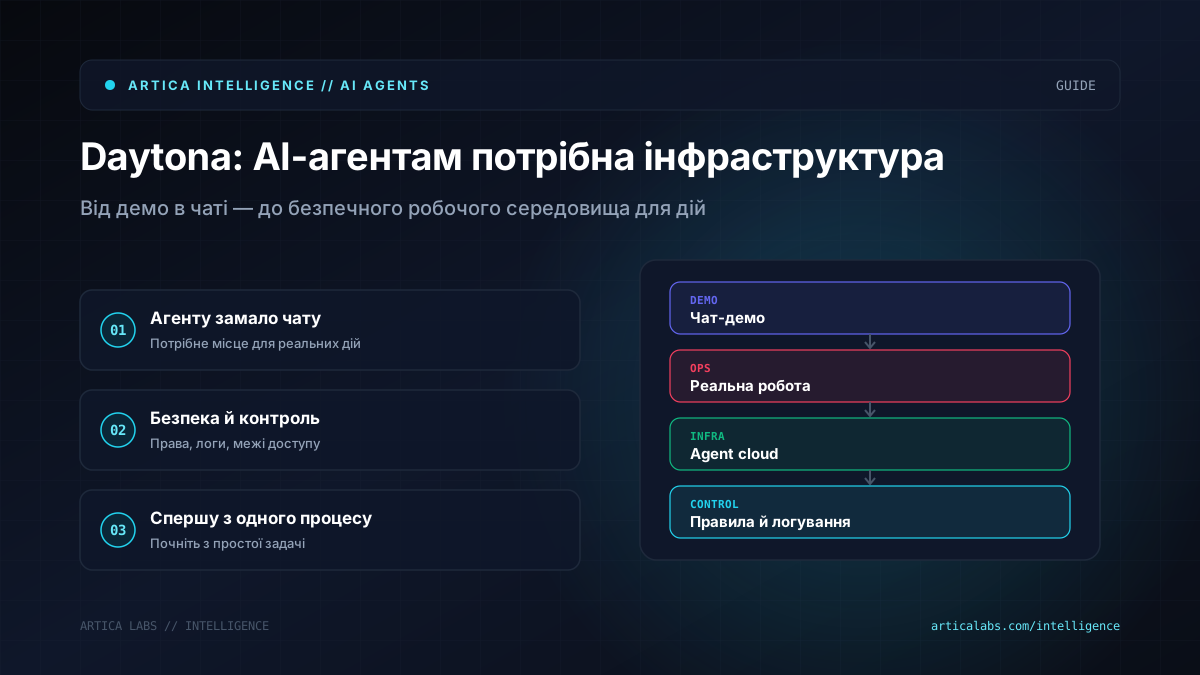
In a demo, an AI agent does everything beautifully: books a meeting, drafts an email, finds the right data in CRM. It looks almost like magic. And then real business begins.
The agent has to log into several systems, calculate something, keep the context intact, avoid breaking a file, not touch someone else’s data, and do it not once, but hundreds of times a day. And ideally without any drama in accounting, support, or the warehouse.
That’s why the news about Daytona is interesting not only to venture investors. It shows where the market is heading: companies are starting to build dedicated infrastructure for AI agents. They’re no longer just plugged into yet another API with a hope that it’ll somehow work.
An agent needs more than chat. It needs a workspace
According to TechCrunch Startups, Daytona Platforms announced a $60 million Series B at a $1 billion valuation. The round was led by FirstMark Growth, which also led the previous $24 million Series A in February. In total, the company says it has raised $91 million.
The list of angel investors is also telling. Daytona names Patrick Collison of Stripe, Tobi Lütke of Shopify, Aravind Srinivas of Perplexity, Eric Yuan of Zoom, Olivier Pomel of Datadog, Adam D’Angelo of Quora, who also sits on OpenAI’s board, and Brendan Foody of Mercor. Qualcomm Ventures, Samsung Next, and Okta Ventures are also mentioned.
So what is Daytona building? It’s a three-year-old New York startup creating a cloud for long-running agents. Traditional cloud infrastructure was designed for services that stay up for a long time and behave in a fairly predictable way. Agents work differently: they launch thousands of short tasks, preserve state between steps, and sometimes operate without a rigid script.
Founder Ivan Burazin describes it as a separate computer for each agent. In practice, that means isolated environments with Linux, Windows, macOS, GPUs, and other services on a single platform.
And that’s where things get especially interesting for business.
Less magic, more operational discipline
Imagine an online store that wants to assign an agent to handle complex customer requests. Check an order status, find a payment, draft a reply, and sometimes create a task for the warehouse. That’s no longer a website chatbot politely answering from canned responses.
That kind of agent needs a safe environment where it can work with files, a browser, CRM, spreadsheets, and internal policies. Otherwise, the business quickly runs into not model quality, but plain earthly questions: who sees what, who can change what, where the audit trail is, and how an error gets fixed.
The same goes for a clinic, an agency, or a delivery service. If an agent is supposed to perform real actions, not just generate text, you have to answer honestly: where does it run, what permissions does it have, what does it see, how do you verify the result, and how do you roll back a bad step?
For small and midsize businesses, this doesn’t mean you need to rebuild your entire IT architecture around an agent cloud tomorrow. We definitely wouldn’t recommend chasing a buzzword you don’t actually need. But treating AI agents as “smart prompts” is already risky. If an agent touches operations, you need rules of the road.
- Start with one process where a mistake won’t stop the business: drafting replies, reconciling data, or gathering information for a manager.
- Define access boundaries: which systems the agent can see, what it can change, and what it can only read.
- Log the actions. If the agent does something, the team should be able to see why and on what data basis.
- Don’t switch on autonomy right away. Start with an assistant mode, then partial automation, and only then independent actions.
The catch is obvious: infrastructure for agents can become the next fashionable label under which everything gets sold. Daytona’s $1 billion valuation does not mean every company now needs a complex agent platform.
But it does point clearly in one direction. Business automation is moving out of the “experimental chat” phase and into environments where agents work like digital employees: with their own workspace, permissions, and accountability.
And that is already a very practical conversation. The question is not whether you’ll have an AI agent. The question is whether you’ll be able to safely give it a job.