
The GPT-6 news is interesting to business not because of the model number itself. The real question is much more down to earth: can a team get an AI solution to work reliably, rather than getting stuck in endless testing of prompts, integrations, and “almost ready” demos?
According to OpenAI News, the company is preparing a practical guide for startups on the GPT-6 family. The announcement mentions model selection, tuning the level of reasoning effort, improving prompts and skills, coordinating tools, and getting workflows ready for production. The full text isn’t out yet, so there aren’t many details. But the focus is already telling: OpenAI is talking not only about what the model can do, but about the entire engineering layer around it.
A strong model won’t carry the whole process on its own
Not long ago, many companies started in the simplest way possible. They took the strongest model, wrote a prompt, connected it to a chat or CRM, and saw what happened. That can be enough for a prototype. For solid day-to-day operations, rarely.
Take an online store. AI has to answer customers, check delivery status, and help with returns. It’s not enough to generate polished sentences. The model has to call the right tools at the right time, avoid mixing up data, understand the limits of its authority, and hand off complex cases to a human when needed. If the GPT-6 guide really puts emphasis on model choice and tool coordination, that’s exactly the kind of work it’s talking about.
The same logic applies in a clinic, an agency, or a delivery service. One request needs to be handled quickly and cheaply. Another calls for deeper reasoning, because a mistake will cost time, money, or customer trust. The reasoning effort setting mentioned in the announcement sounds very practical here: not every request needs maximum “brainpower.”
What to prepare while the full guide is still unavailable
We wouldn’t wait for GPT-6 as if it were a magic button. It’s better to prepare the ground now. When new models become more widely available, the advantage will go not to those who open the dashboard first, but to those who already have clear processes, data, and quality criteria in place.
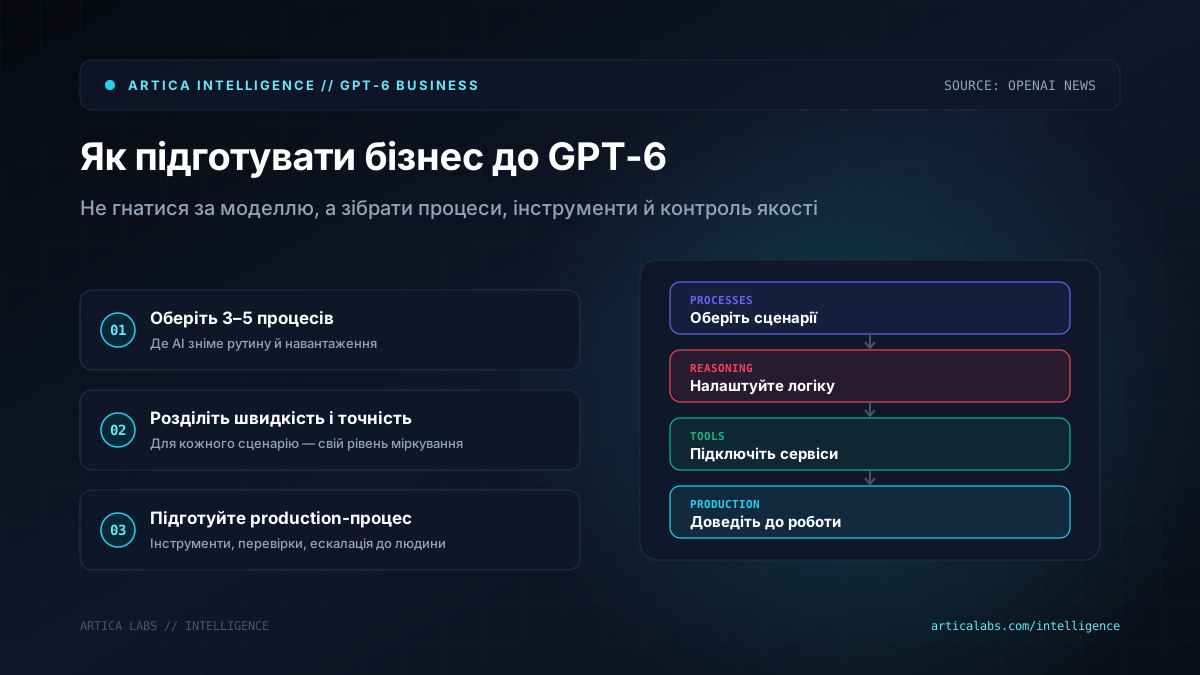
- List 3–5 processes where AI can remove routine work: support, request handling, preparing commercial offers, internal document search.
- For each process, define where speed matters and where accuracy and deeper reasoning matter more.
- Map out which tools the agent should call: CRM, spreadsheets, email, booking system, knowledge base.
- Think through validation in advance: who reviews errors, how often prompts are updated, when AI passes a task to a human.
And that’s where things get really interesting. Businesses often fall in love with demos. In a Slack thread, everything looks great, but in a real flow of requests, the agent starts to lose the thread, repeat itself, or act without context. That’s why the production-ready workflow mentioned in OpenAI’s announcement is not a minor technical detail. It’s the difference between a toy and a system you can trust with part of your operations.
For founders and SMBs, the smart move right now is not to chase the biggest model, but to learn how to design AI processes. Start with a small scenario, measure the results, and gradually add tools. Then, when the full GPT-6 guide from OpenAI becomes available, you’ll be able to apply it not to an abstract idea, but to a live business process.