
Monday morning. You open your CRM and see a very familiar picture. Managers are once again manually moving leads from the website form. The marketer is pulling together a report in a spreadsheet and copying data from ad platforms. The operations manager is sending customers the same updates about order status. In the chat, the team is already firing off questions: who replied to the customer, where’s the invoice, why did the lead disappear?
At that moment, someone almost inevitably says, “We need to automate everything. And plug in AI.” Sounds reasonable. But half an hour later, a different question comes up: how do you know this isn’t just an expensive toy?
And that’s where things get interesting. ROI from automation and AI projects is rarely captured by one neat formula. Because the benefit doesn’t always sit in a line item like “saved payroll.” Often it’s faster customer responses, fewer mistakes, more processed requests, clearer workflows, and less pressure on the team. Some of that can be counted in money. Some of it has to be estimated through risk, time, and quality.
Bad news: if you look only at the integration bill, the decision will be skewed. Good news: for a first sober estimate, you don’t need a complex financial model. It’s enough to honestly describe the process, calculate the current cost of manual work, include implementation and maintenance costs, and then test the hypothesis on a small pilot.
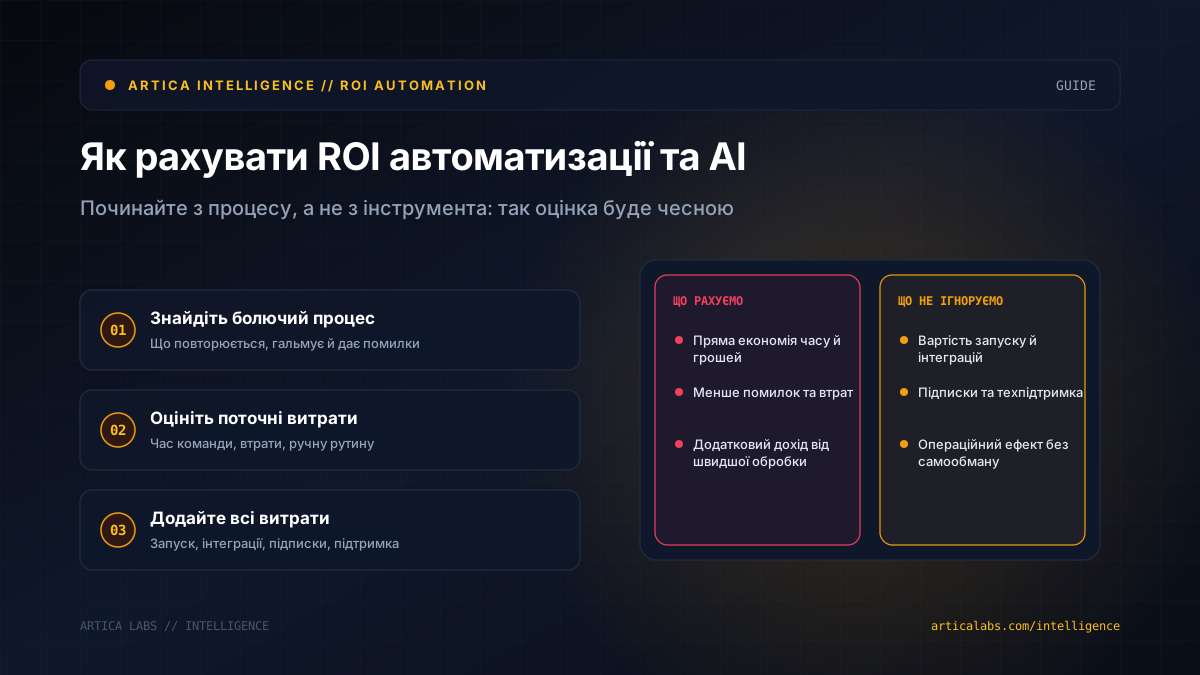
Start with the painful process, not with AI
A typical owner mistake is starting with the tool. “We need a chatbot,” “let’s build an LLM-based agent,” “I want RAG over our knowledge base,” “we need n8n because everyone’s talking about it.” The tool may be the right one. But on its own, it doesn’t answer the ROI question.
It’s better to start with the process that already hurts. Imagine an online store. Every day it gets questions about delivery, payment, product availability, and returns. Some customers wait hours for a response. Some write again. Some simply leave. That’s where you can already think about an AI support assistant, response templates, CRM integration, and delivery services.
Or a clinic. Administrators manually confirm appointments, remind patients about visits, reschedule times, and answer routine questions. In that case, automation doesn’t necessarily “replace the administrator.” More often, it removes the routine that keeps the person from doing proper work with patients.
For an agency, it might be collecting data for weekly reports. For a delivery service, it might be updating statuses and notifying customers. For SaaS, it might be initial lead qualification or answering common support requests.
A good automation candidate is easy to spot: the process repeats often, has clear rules, takes a lot of time, or regularly creates mistakes. If the process is chaotic and nobody can explain how it should work, AI won’t save it. It will just speed up the chaos.
The market is moving this way too. On Product Hunt, among recent products, you can see Cosmic AI Support Agent and Customer Service AI for Etsy. That doesn’t prove every business needs AI support tomorrow. But the signal is clear: customer support automation is becoming its own product category, not just a hobby for enthusiasts.
The ROI formula is simple. The numbers are where people stumble
The basic formula looks like this:
ROI = (benefit from the project − project costs) / project costs × 100%
On paper, everything is tidy. The problem is that businesses often plug in desired numbers instead of real ones. For example: “AI will save us 80% of support time.” Where does 80% come from? Nobody knows. It just sounds convincing.
It’s better to calculate from current reality. Say we’re looking at an online store. A manager spends 10 hours a week answering routine customer questions. This is not market statistics, just a hypothetical model for calculation. If one hour of work, including taxes, overhead, and management, costs the business a certain amount, you can calculate the monthly cost of that routine. Then estimate what part can really be automated without losing quality. Not 100%, because complex questions, conflicts, and edge cases will still need people.
The benefit can have several components. There’s time saved by the team, fewer mistakes like wrong addresses, missed requests, or duplicate orders. There’s additional revenue if automation helps process leads faster and not lose potential customers. And there’s control: you finally see where the request is stuck and who owns it.
There’s a trap here. Not every hour saved can automatically be turned into money. If someone frees up 5 hours a week, but those hours don’t go into sales, service, or other useful work, the financial effect will be smaller. That doesn’t mean the project is bad. It just means ROI has to be calculated without self-deception.
We like to split the benefit into two categories: direct financial and operational. Direct means money you can see in the P&L or cash flow. Operational means speed, quality, transparency, and less pressure on the team. That should be included too, but you shouldn’t disguise it as precise dollars when it isn’t precise.
The developer bill is only part of the cost
When an owner asks, “How much does automation cost?”, they often mean the fee for a specialist or a team. In reality, the cost is broader. If you don’t account for it, ROI looks nice at the start and awkward a month later.
It starts with process analysis. Someone has to describe how everything works now, where the data lives, who makes decisions, and what exceptions happen. That’s your team’s time. It’s easy to miss because nobody sends a separate invoice for it.
Then comes building the solution. That might be a workflow in n8n or Make, a CRM integration with email, Telegram, the website, a payment system, or a warehouse. If we’re talking about AI, add prompts, response validation logic, knowledge-base work, sometimes RAG, access rights, and activity logging.
Subscriptions also need to be included. LLM providers, automation services, CRM, hosting, vector databases, monitoring tools. In a small pilot, this may be a modest amount. At scale, when request volume grows, costs increase. Not a disaster, but they have to be visible.
There’s also maintenance. Automation doesn’t live in a vacuum. Delivery rates change, CRM structure changes, email templates change, business rules change, assortment changes, sales scripts change. If the process matters, it needs an owner. Not “some technical contractor out there,” but someone inside the business who understands what should happen.
And finally, team training. The best scenario can fail if people don’t understand when to trust it and when to step in. Especially with AI. A model can sound very confident even when it’s wrong. That’s why you need rules: which responses can go out automatically, which ones need review, and which topics the system must not handle autonomously.
A pilot is more useful than a pretty presentation
If the process is chosen well, there’s no need to build “one AI platform for the whole business” right away. On a strategy session, that sounds nice. In reality, it often collapses under its own weight.
It’s better to take one narrow scenario. For example, automatically creating a lead from a website form, checking for duplicates, notifying the manager, and sending the first email to the customer. Or an AI draft reply for support based on the knowledge base, but with mandatory human approval. Or pulling data from ad accounts into a weekly report without manual copy-paste.
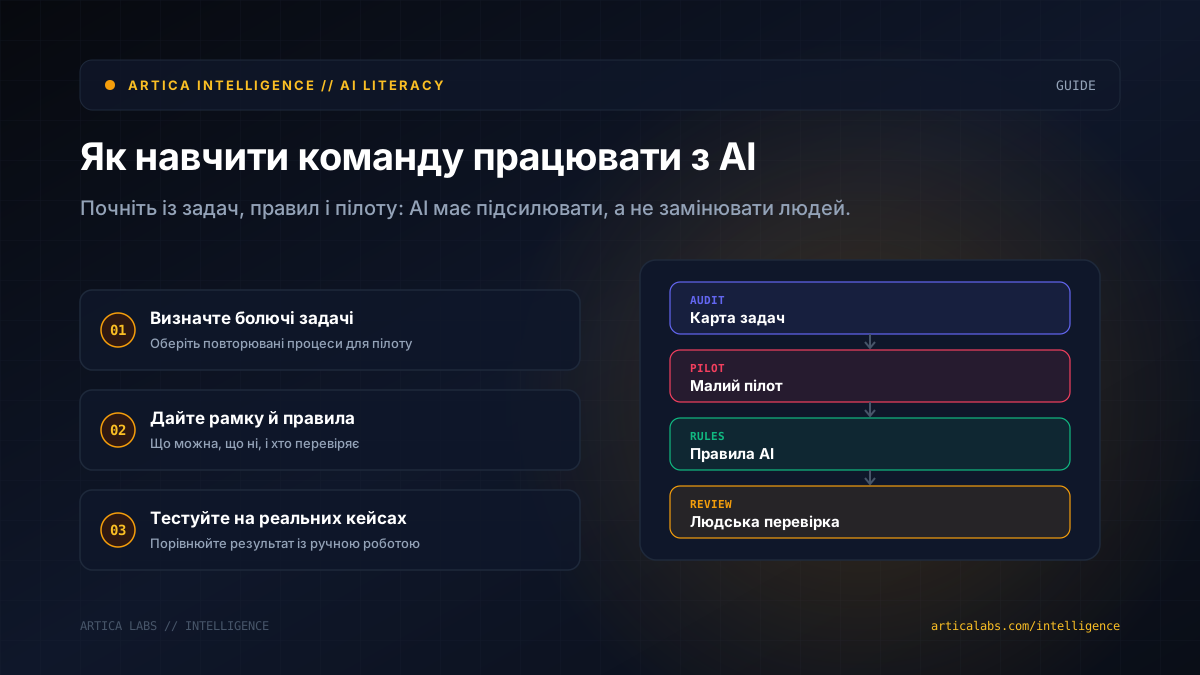
The pilot should answer three questions. Does the technology work on your data? Does the team accept it? Is there a measurable effect?
Here’s a short plan you can start with without unnecessary bureaucracy:
- Choose one process that repeats at least several times a week and has an owner on the team.
- Describe the current state: how much time it takes, who is involved, what errors happen, where money or customers get lost.
- State the expected result in one sentence, for example “reduce manual handling of routine requests” or “eliminate duplicate leads.”
- Calculate the baseline monthly cost of the process. Not perfectly, but honestly: people’s hours, mistakes, delays, lost revenue if you can justify it.
- Estimate the pilot costs: team work, external development, subscriptions, support, training.
- Launch a limited version on part of the flow. Not for all customers and not across all departments.
- After 2–4 weeks, compare the metrics before and after. If there isn’t enough data, extend the test or narrow the hypothesis.
- Make a decision: scale, redesign, or shut it down. A closed pilot is still a result if it saved you larger costs.
A proper pilot should not prove the owner was right. It should show what is actually happening. Sometimes it turns out the problem isn’t manual work, but bad rules. Sometimes a simple automation flow is enough without any LLM. Sometimes AI really does deliver a strong effect because it handles a large amount of repetitive information faster than a person.
Where businesses most often get ROI calculations wrong
The first mistake is counting only payroll savings. In small businesses, automation often doesn’t reduce headcount. It allows the same team to handle a bigger volume, respond faster, and burn out less. If the owner expects every AI project to eliminate one role immediately, disappointment is almost guaranteed.
The second is not having a baseline. The team launches automation and then asks, “Is it better?” Everyone feels it is. But how much time was saved, how many errors were removed, how did response time change — nobody knows. Without a pre-launch measurement, ROI turns into a conversation about feelings.
The third is forgetting about data quality. An AI assistant that answers based on an outdated knowledge base can quickly cause problems. Automation that pulls data from a CRM where half the fields are filled out inconsistently won’t work miracles either. Before a complex AI project, you sometimes need to do boring work: remove duplicates, agree on filling rules, update reference data.
The fourth is automating exceptions instead of the main flow. Businesses remember the most complex 5% of cases and immediately try to teach the system to handle them. Budget goes up, launch gets delayed, the team gets tired. It’s smarter to first remove the simple 50–70% of routine work, if the process allows it, and leave the difficult cases to people.
The fifth is not assigning an owner after launch. Automation without an owner ages quickly. Someone changes a field in the CRM, someone renames a funnel stage, someone updates a sales offer, and the workflow keeps running by the old rules. Then people say, “AI doesn’t work.” In reality, process management doesn’t work.
AI risks: caution is needed, fear is not
AI adds a new layer of risk to automation. Don’t demonize it, but don’t treat it like a regular spreadsheet macro either.
The first risk is a wrong or fabricated answer. If AI helps draft an email, a mistake is annoying. If it independently advises a patient, a client of a financial company, or provides legally sensitive information, the stakes are different. Autonomy should depend on risk. Where the risk is high, human review is required.
The second risk is confidentiality. Sending personal data, commercial terms, medical, or financial information to external AI services without rules is dangerous. You need to understand what data goes where, who has access, whether it can be anonymized, and whether separate policies and contracts are required.
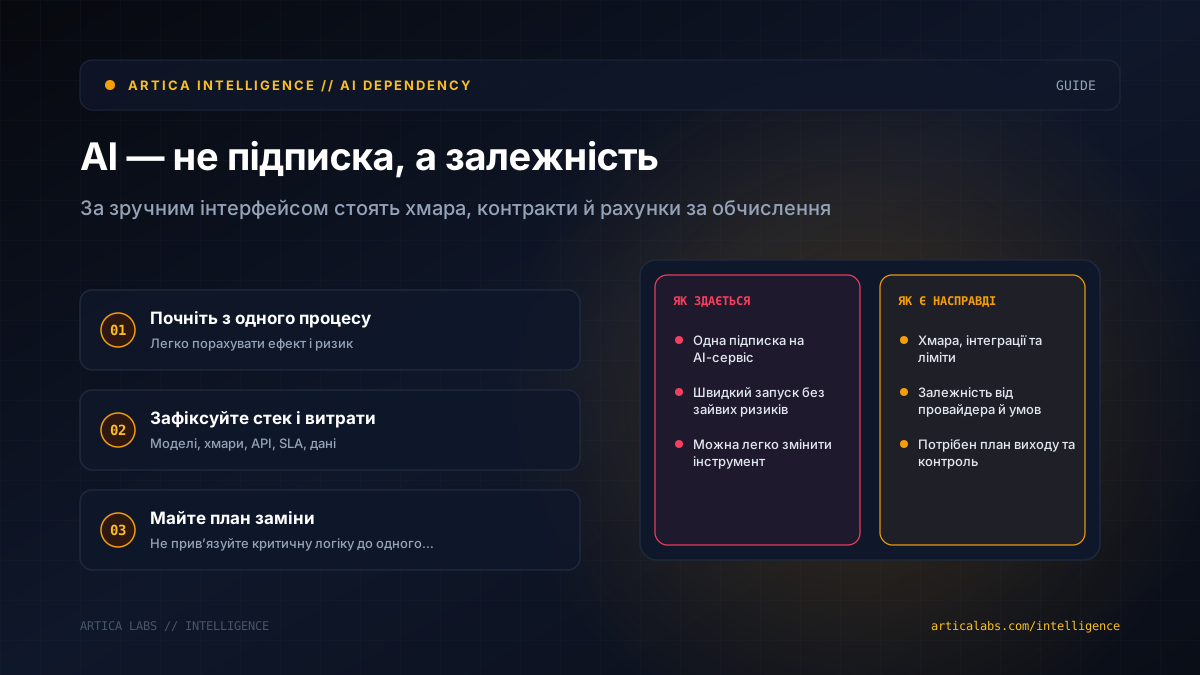
The third is dependence on a single tool. Today the service is convenient and cheap; tomorrow it changes pricing or functionality. That’s not a reason to do nothing. But for important processes, you need a fallback: what happens if the API is unavailable, the limit is reached, or the model responds slowly.
The fourth is team resistance. People may fear automation is there to replace them. Or, on the contrary, they may expect magic from AI and stop checking the results. Both are bad. The team needs to understand which work the system takes over, which decisions remain human, and how results will be evaluated.
For an owner, this means one simple thing: ROI must be calculated together with risk. A project with high potential benefit but no quality control may cost more than it seems. Sometimes the best first-stage solution is not full automation, but a “AI suggests, human approves” mode.
How much resource to allocate and when to expect results
There’s a temptation to ask: “What’s the average payback period for an AI project?” But the average answer is almost useless here. Automating a report, integrating a CRM with a website, and building an AI support agent with a knowledge base are different projects in terms of complexity, risk, and budget.
For a small business, the healthy approach is this: first diagnosis, then a small pilot, then a decision about scaling. Diagnosis requires the process owner, someone from operations, and someone who understands data or systems. If everyone is busy and nobody can spare a few hours, it’s better not to start. The project will get stuck.
The pilot should be small enough that you’re not afraid to shut it down, and real enough that it tests the business effect rather than a demo version. Don’t test AI on made-up data if it will later work with messy customer messages. Don’t build perfect architecture if you still don’t know whether the team will use the result.
Results should be evaluated not only at the end. During the pilot, you can already see where friction appears: the data is poor, the integration is unstable, the team bypasses the system, customers ask questions that aren’t in the knowledge base. That’s not a failure. That’s material for a decision.
If after the pilot you see time savings, fewer mistakes, or faster request handling, you can scale. If there is an effect, but it’s weaker than expected, you need to change the process or narrow the scenario. If there is no effect, it’s better to stop honestly. The worst thing is to keep investing money just because you regret what you’ve already spent.
Our editorial position is simple: automation and AI should go through the same test as any other business investment. Not “it’s trendy,” not “our competitors are already doing it,” but “what problem are we solving, how much does it cost us now, what risk are we taking, and how will we know it got better.”
We don’t believe in magical ROI from AI. But we do believe in well-chosen processes, honest numbers, and short pilots. That’s what separates useful automation from a pretty presentation. If an owner is ready to look at processes without self-deception, AI becomes a normal working tool. Not a festival of innovation, but a way to remove unnecessary manual work and give the team more room for the tasks where people are truly needed.
Artica Labs sometimes helps businesses go through this path: from process diagnostics to an automation MVP or an AI agent. But the first step is still yours: choose one painful process and calculate how much it costs today.