
When product IT companies lay people off, it affects more than the job market. For the owner of an online store, clinic, agency or delivery service, it’s a signal that money has become more expensive, priorities are being reviewed more strictly, and every role on the team has to show what business problem it actually solves.
And that’s where things get interesting. Layoffs in the tech sector do not mean you should stop growing or put automation on hold until “better times.” Quite the opposite is often true. Companies start looking more closely at where processes can be simplified, which products are not paying for themselves, and where the team spends hours every day on manual work that systems could have been handling long ago.
Promova, SaaSJet and Centro are reshaping their teams
According to DOU, layoffs are happening at three Ukrainian IT companies at once. The new wave started at the EdTech company Promova from the Genesis ecosystem. The Ternopil-based product company SaaSJet is also cutting staff, while Centro is known to have laid off 40 developers and QA engineers.
At Promova, this is already the third wave of layoffs since the end of 2025. In November 2025, the company laid off 28 specialists, or about 15% of the team. After that, according to DOU, Promova had 157 employees left. In August, another 63 specialists were affected by layoffs. At the time, the company explained the decision by organizational changes and a review of its structure in line with business priorities.
After the August wave, employees were promised one month’s salary as severance, compensation for unused vacation days, temporary retention of corporate benefits, recommendation letters and help with resumes.
At SaaSJet, the company told DOU that the layoffs affected 5 people out of a team of 70 employees. The company said this was due to cost optimization and a reallocation of resources toward customer-facing work, sales and the development of core products. DOU has also reached out to Promova and Centro for comment and is awaiting clarification on the scale and reasons.
For small and mid-sized businesses, this is not a signal to “cut everything”
The first reaction may seem obvious: if even IT is laying people off, then costs need to be slashed immediately. But that’s too blunt an instrument. You can cut fat, or you can cut muscle. The difference won’t be obvious right away, but only after a few months, when clients are waiting longer for replies, managers start losing leads, and the owner once again becomes the only person keeping everything in their head.
A more practical approach is to look at processes as if they were a product. For example, imagine a clinic where administrators manually move requests from messengers into a CRM. Or an online store where a manager checks payment and delivery statuses every day. In such cases, automation through n8n, Make or an AI agent does not necessarily replace a person. More often, it removes routine work so the team can focus on sales, service and repeat purchases.
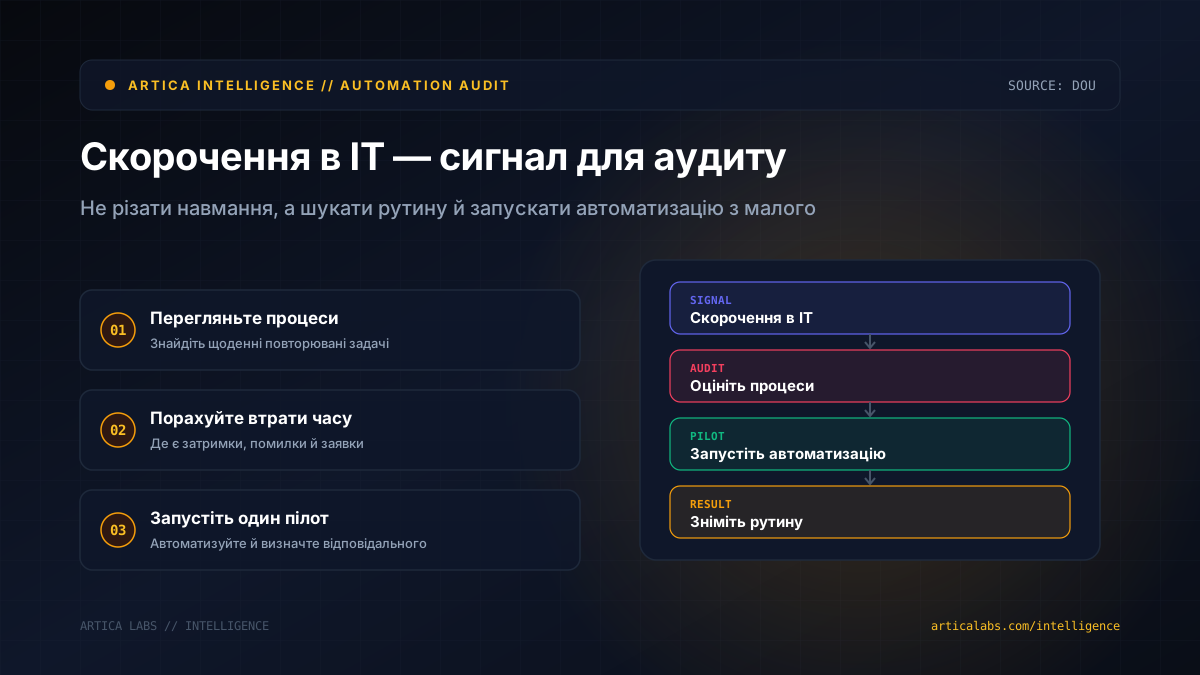
Where to start without making drastic moves:
- list 5–7 processes that repeat every day and take time away from the team;
- calculate where manual work creates delays, mistakes or lost leads;
- choose one process for a quick pilot instead of rebuilding the entire company in a week;
- check who will be responsible for maintaining the automation after launch.
There is also a catch. Automation does a poor job of fixing chaos. If a company has no clear rules for who takes in a lead, who approves a discount, or who handles a client after payment, AI will only spread that confusion faster across the system.
For us, this news is not about fear. It is more about the market growing up. Businesses will increasingly ask not “how many people are on the team?” but “what result does each function deliver?” And that’s a good time to calmly review processes, identify routine tasks and start with a small automation pilot. No hype. Just a calculator and common sense.