
The unsettling part of this story isn’t that a major IT company got hacked somewhere. It’s something worse. A business can have a solid team, pay for cloud services, make backups, and still face risk through a vendor that was given access to its systems.
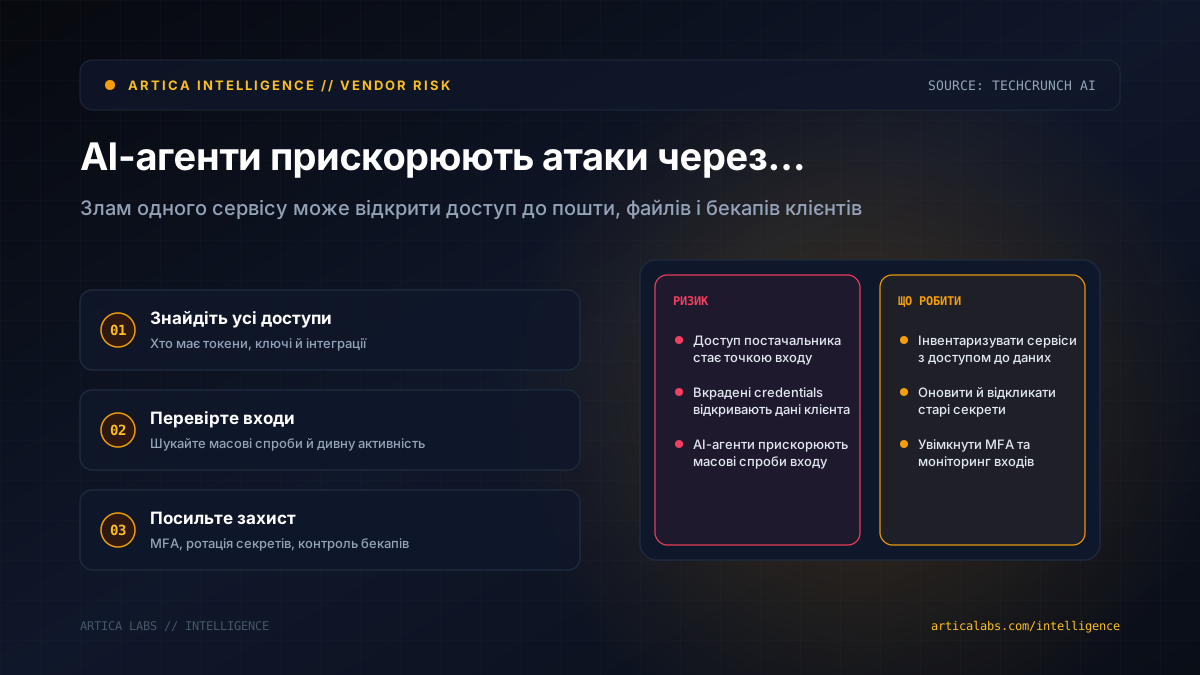
And this is where it gets really interesting. AI agents that companies use for sales automation, support, or analytics can also speed up attacks. This isn’t magic or a hacker movie. It’s just very fast execution of a large number of actions that used to take more time and more hands.
The problem starts where a service has access to your data
According to TechCrunch AI, researchers at Microsoft link the attack on ConnectWise to China-aligned hackers. ConnectWise is a major provider of IT management, remote access, and cloud backup services. Microsoft says the attackers breached ConnectWise’s cloud backup service and stole application credentials — the credentials used to connect ConnectWise with corporate customers.
The result is simple and very unpleasant. With those credentials, hackers could log into a customer’s Microsoft-hosted environment as if they were an authorized user. From there, the door opens to email and other files.
Microsoft says the attack affected roughly 2,250 organizations. The pace was nearly 3,000 login attempts per minute. The company directly links that speed to the use of AI agents. In particular, it mentions ARTEX, an open-source AI framework that works with AI models for stress-testing cyber defenses.
According to Microsoft, the same software was also used in a recent compromise of financial systems in South Korea. There, many systems had weak security and no multi-factor authentication.
ConnectWise said it has suspended access to its cloud backup system, is investigating the incident, and is working to restore the service.
What businesses should check before this becomes their incident
This isn’t just a story for banks or large enterprises. Imagine an online store. It keeps customer emails, supplier contracts, and financial files in Microsoft 365, and sends backups to an external IT provider. If the link between that provider and the Microsoft environment is compromised, the store owner may learn about the problem too late.
The first thing we’d recommend in this situation is to make a list of the services that have technical access to email, files, CRM systems, backups, and admin panels. Not the list of what the company pays for every month, but specifically who can access your data or connect to it through tokens, keys, and integrations.
- Check whether you use ConnectWise or vendors that may operate through it.
- Review sign-in logs in your Microsoft environment: mass attempts, unusual countries, nighttime activity, new applications.
- Update or revoke credentials for integrations that no one has reviewed in a long time.
- Enable multi-factor authentication everywhere possible, especially for admins.
- Ask your IT vendor to explain in writing how it stores access credentials and what it does during an incident.
There’s one trap here. Backups are often treated like insurance: if something breaks, we’ll restore from backup. But backup systems also have access — sometimes very broad access. That’s why they need to be controlled at least as tightly as your CRM, payment dashboard, or website admin panel.
For a founder, clinic, agency, or delivery service, the practical starting point is pretty straightforward: access inventory, MFA, secret rotation, and login monitoring. AI has made attacks faster. Businesses will have to spot problems and respond faster too.